
Last Updated on December 16, 2014 by admin
The Vice-Chancellor, Professor Olusola Oyewole, has reiterated the Management’s position at improving on teaching and learning activities in the University, and the need make learning needs student-centered. Professor Oyewole made this known at the maiden training programme on “Ethics of Examination and Invigilation to Newly-Employed Academic Staff and Departmental Officers”, held recently in the University. According to him, “there is the need to make learning to be student-centred as well as promote learning outcomes, skills and competencies.” The Vice-Chancellor said the Training Manuals would be mass produced and distributed to all academic staff to aid teaching and learning.
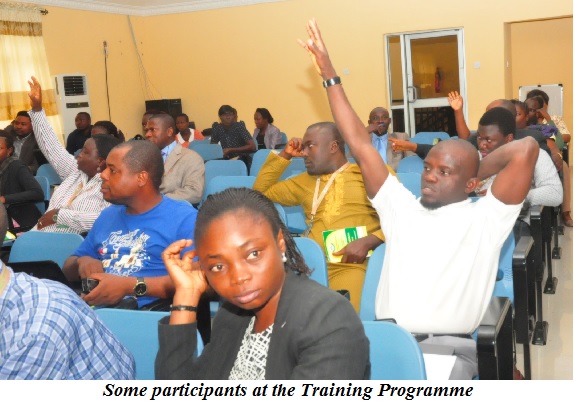
The Chairman, Time Table and Examinations Committee (TIMTEC), Dr. Adebola Osipitan, described examination as a test of knowledge or the ability of students, adding that it allows students to concentrate on their studies by training them on various things like punctuality, writing skills, timing sense and expression of thoughts. Dr. Osipitan added that the integrity of the examination was of paramount importance to Management of the University. He also stressed the importance of invigilation, saying that it should not be undermined. “Invigilators have important roles within the examination period to ensure that examinations run effectively and are conducted in a fair and appropriate manner,” he declared. The TIMTEC Chairman stated that unless a matter was of utmost importance, students should not be interrupted during invigilation, adding that invigilators were also not expected to perform any other routine or task during an invigilation.
He added that the training programme became imperative in view of the fact that there was an influx of new academic staff into the University within the last three years. His words, “training and re-training are essential and things are fast changing. The University is known for quality examination”. The Chairman said the training was designed to draw the attention of his colleagues to what they were supposed to do under emergencies like examination malpractices be it minor or major. He, however, commended the University Management for its determination at sustaining the tradition of unrivaled conduct of examination.

In his lecture titled, “Conduct of Invigilators Before, During and After Examination and Responsibilities of HOD as Chief Examiner”, Dr. Olusegun Idowu of the Department of Animal Nutrition, described an invigilator as someone who watches candidates, to prevent cheating during examinations. The former Chairman of TIMTEC added that a Chief Examiner is a person who sets or marks an examination, as he highlighted the role of an invigilator before, during and after an examination. Dr. James Ikechukwu, also a former Chairman of TIMTEC, in his lecture titled, “Rules and Regulation Governing Examination, Handling of Examination Materials and Cases of Examination Malpractices in FUNAAB”, explained how the students and the invigilators, Chief invigilator as well as the Chief Examiner should comport themselves during examinations, nothing that sensitive materials should be handled properly. In his lecture titled, “Invigilation at the Health Centre, Special Centre and e-Examination Venues”, the former alternate Chairman of TIMTEC, Dr. Eniola Fabusoro, discussed the rudiments to take into consideration before the commencement of examinations, while Mrs. Tawakalitu Ayelotan, of the Information Communication and Technology Resources Centre (ICTREC), in her lecture titled, “Management of e-Examination and Question Authoring”, described management of e-examinations as the organisation and co-ordination of activities involved in an electronic examination.
