

Last Updated on November 29, 2026 by Olasunkanmi Olajide
By Femi Dansu
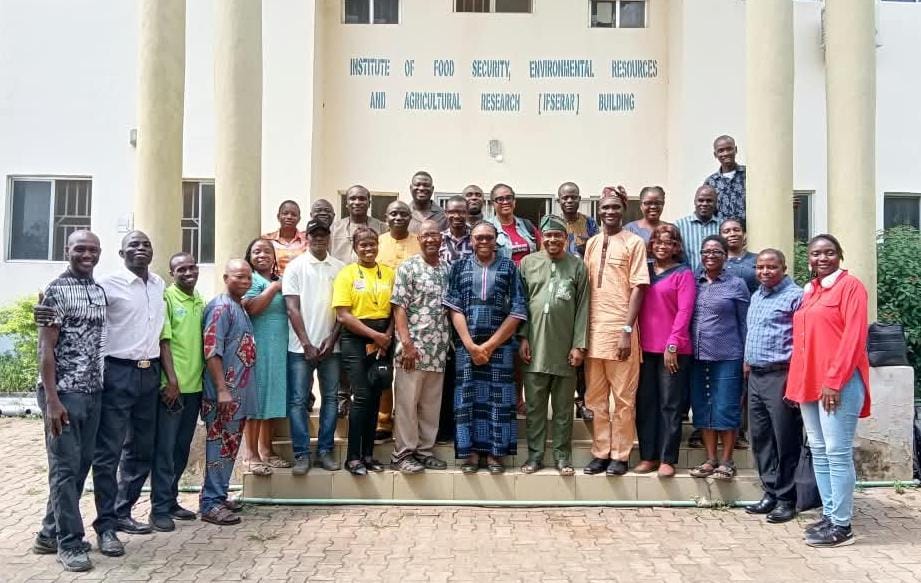
The Institute of Food Security, Environmental Resources and Agricultural Research (IFSERAR), Federal University of Agriculture, Abeokuta (FUNAAB), has highlighted the importance of species and season-specific fertiliser application in boosting pepper productivity, improving fruit nutritional quality and promoting sustainable agricultural practices. The recommendation featured prominently at the Institute’s November Monthly Seminar, held on November 25, 2026.
Presenting a paper titled “Yield, Nutritional Content and Patterns of Three Field-Grown Peppers (Capsicum spp. Linn.) as Affected by Foliar Spray of Calcium and Potassium Nitrates,” Dr. Abiodun Akinbule highlighted the economic, nutritional and pharmaceutical importance of pepper, particularly to rural livelihoods in
Southwestern Nigeria. He observed that many farmers still relied on blanket fertiliser recommendations that failed to account for differences among pepper species and cropping seasons, often resulting in suboptimal yields, inconsistent fruit quality and postharvest losses.

Sharing the findings of the study, Dr Akinbule explained that three commonly cultivated pepper species, Capsicum annuum (sweet pepper), Capsicum chinense (hot pepper) and Capsicum frutescens (chilli pepper), were evaluated during early and late cropping seasons using foliar applications of calcium nitrate and potassium nitrate. He disclosed that calcium nitrate applied alone consistently produced the highest fruit yields in C. annuum and C. chinense across both seasons, while C. frutescens recorded optimum yield with potassium nitrate alone during the early season. Different application treatments also proved beneficial for the latter during the late season.
The researcher further established that the nutritional responses of the pepper species varied according to their genetic characteristics and seasonal growing conditions. Parameters such as mineral composition, Vitamin C, carotenoids, total soluble solids, titratable acidity and sugars responded differently to the fertiliser treatments, indicating that increased fruit yield did not necessarily translate into uniform improvements in nutritional quality. He added that C. frutescens generally demonstrated superior bioactive and nutritional attributes during late-season cultivation, except in mineral composition.
In a further demonstration of technology-driven agricultural research, the study used machine learning techniques, particularly Principal Component Analysis (PCA) and K-means clustering, to identify nutritional patterns and classify the pepper species by overall fruit quality. The analysis identified C. chinense treated with potassium nitrate alone, alongside C. frutescens subjected to potassium nitrate alone or alternating applications of calcium and potassium nitrates, as having the most nutritionally balanced profiles across the evaluated quality parameters. Correlation analysis also revealed stronger relationships between fruit nutritional characteristics and yield during the late season than in the early season.
Highlighting the practical implications of the findings, Dr Akinbule urged pepper farmers and agricultural extension agents in southwestern Nigeria to adopt species and season-specific fertiliser application rather than depend on uniform recommendations. He recommended sole calcium nitrate application for C. annuum and C. chinense, while appropriate potassium nitrate and alternating calcium and potassium nitrate treatments were advised for C. frutescens, depending on the cropping season. He further recommended prioritising calcium nitrate over potassium nitrate during early season cultivation where reducing anti-nutritional hydrogen cyanide levels in pepper fruits is a concern.
The seminar concluded that integrating conventional agronomic practices with modern data analytics offers significant opportunities for advancing precision agriculture, increasing crop productivity and improving the nutritional quality of agricultural produce. The findings also highlighted the need for agricultural interventions that recognise variations in crop species and seasonal conditions to achieve better production outcomes.
#SDG2, #SDG9, #SDG12, #SDG17