
Last Updated on May 18, 2026 by Olasunkanmi Olajide
By Femi Dansu
A Research Fellow at the Institute of Food Security, Environmental Resources and Agricultural Research (IFSERAR), Dr. James Fadeyi, has unveiled innovative climate-smart strategies aimed at enhancing sorghum productivity in the face of worsening climatic conditions.
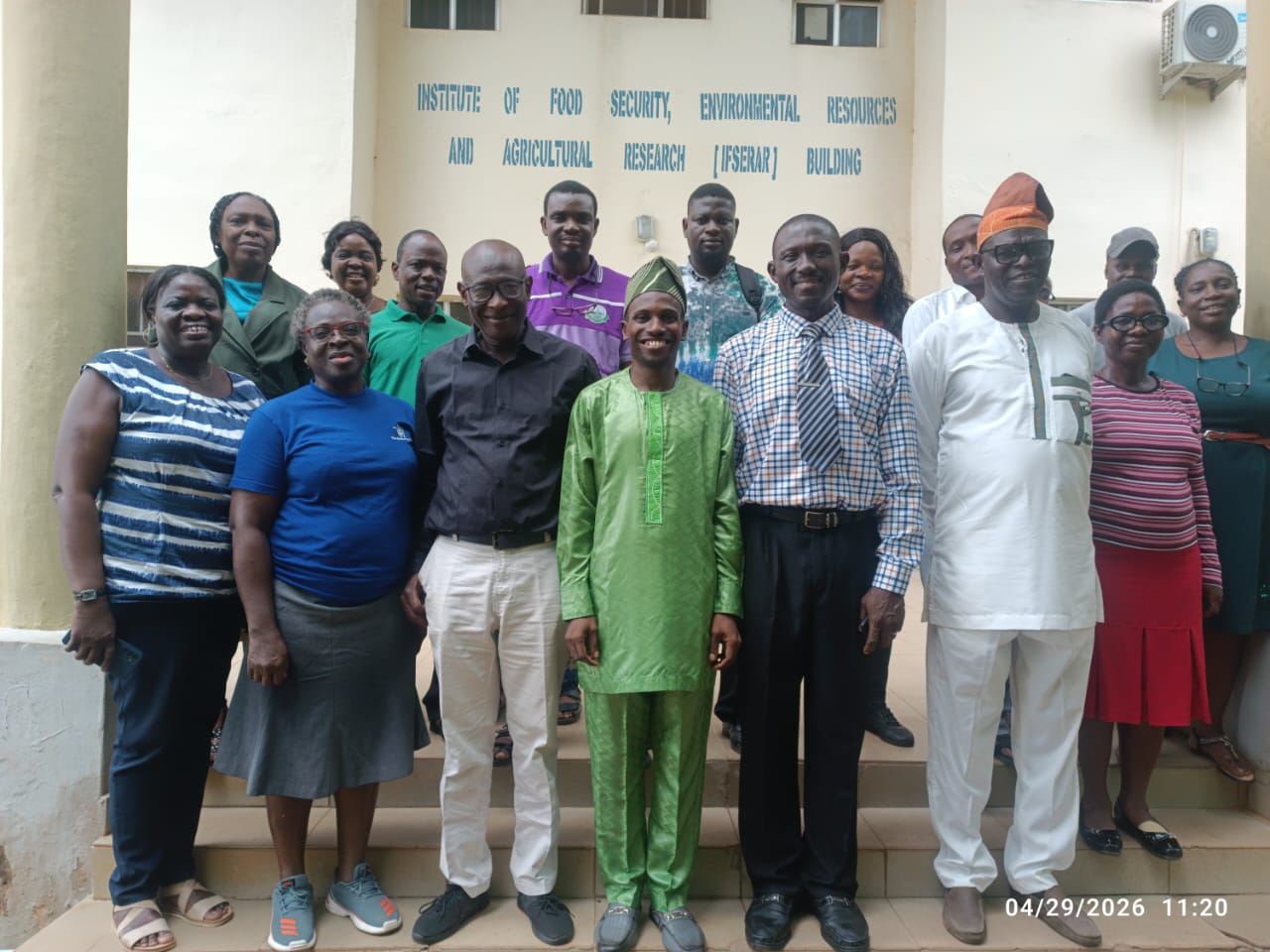
Dr. Fadeyi presented the findings at the Institute’s Monthly Seminar held today, April 29, 2026, where he, alongside his research team, examined the impact of organic soil amendments on improved sorghum varieties within the forest–savannah transition agro-ecology, an area increasingly vulnerable to climate variability.
The presentation underscored the urgency of adopting Climate-Smart Agriculture (CSA) practices, in line with global efforts to simultaneously improve productivity, strengthen adaptation, and mitigate climate change impacts.
Highlighting the rationale for the study, the researchers pointed to persistent yield gaps of between 30 and 60 percent in sorghum production, particularly among smallholder farmers. They noted that despite sorghum’s inherent drought tolerance, factors such as poor soil fertility, erratic rainfall, and nutrient stress continue to limit optimal yields. The team also identified critical knowledge gaps relating to soil nutrient dynamics and varietal performance under changing climatic conditions.
To address these challenges, the study evaluated three improved sorghum varieties—SAMSORG 44, SAMSORG 47, and SAMSORG 48, under varying levels of water stress, while also assessing the influence of poultry manure on growth and yield performance. Findings revealed that severe drought stress had no significant effect on key agronomic parameters, including growth, phenology, and yield.
Notably, clear varietal differences were observed, with SAMSORG 44 consistently outperforming the other varieties in grain yield and related components across all stress conditions. The study further demonstrated that the application of poultry manure significantly improved plant performance, with an optimal rate of 5.0 tonnes per hectare identified for maximum productivity.
Based on the findings, the researchers recommended SAMSORG 44 for cultivation in drought-prone areas and regions with short rainy seasons due to its superior resilience and yield advantage. Conversely, SAMSORG 47 and SAMSORG 48 were considered more suitable for areas with longer rainfall duration or access to supplementary irrigation. The team also advocated the routine application of poultry manure at 5.0 tonnes per hectare to enhance soil fertility and crop performance.
In addition, the researchers called for expanded on-farm trials across diverse agro-ecological zones to further validate the results and facilitate wider adoption of the recommended climate-smart practices.